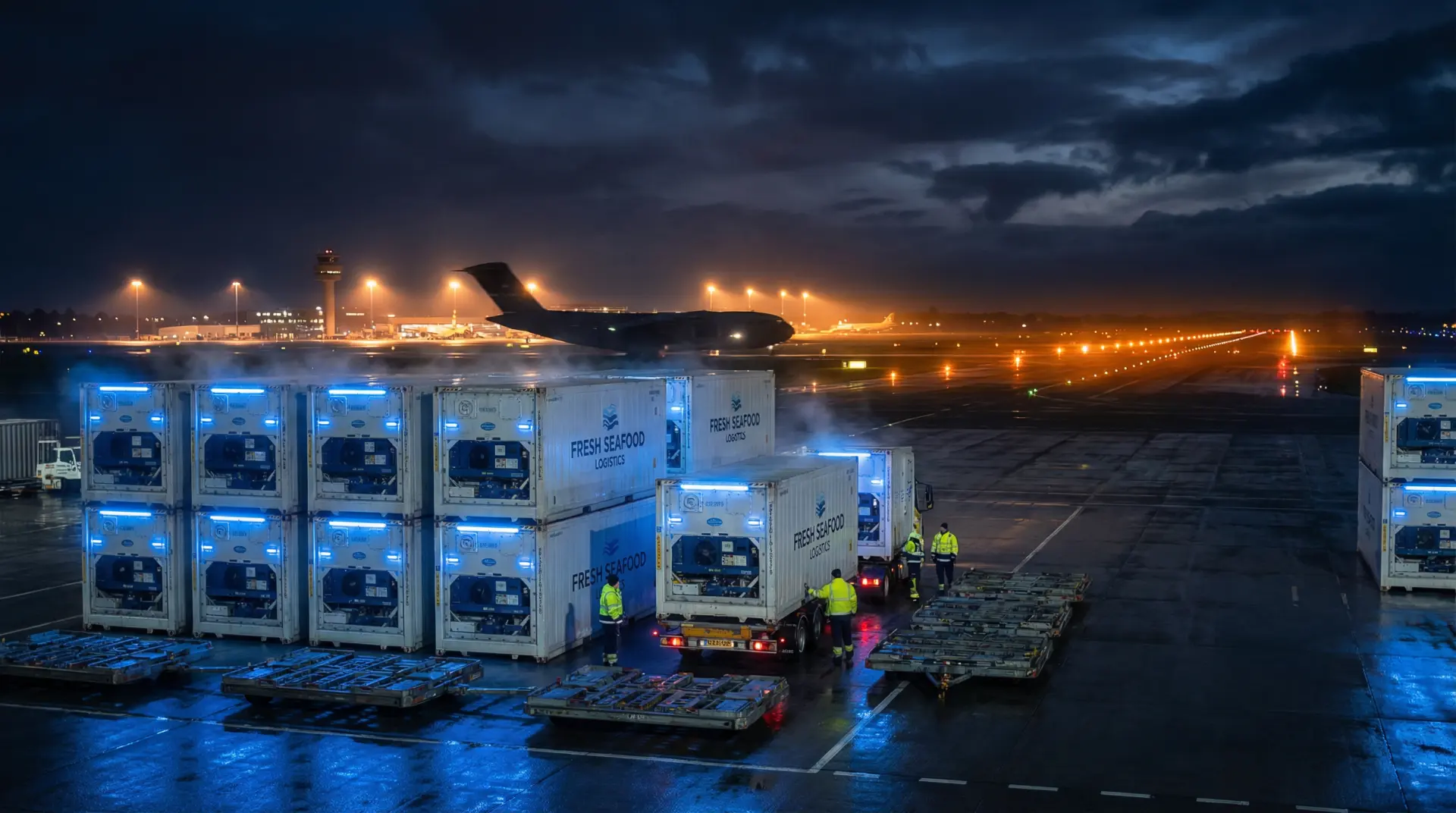
Pacific Seafood × AquaChile × Cermaq
From Runway to Route
One-Screen Summary
Everything a CIM reader needs to know, scannable in under 60 seconds.
Context
The situation that demanded action
Pacific Seafood distributes fresh salmon from two of the world's largest aquaculture producers: AquaChile (30+ years in Chilean aquaculture) and Cermaq (part of Mitsubishi Corporation).
Stakes
What was at risk if we failed
The supply chain: Chilean farms → Santiago (SCL) airport → US gateway airports (LAX, MIA, JFK) → Pacific Seafood distribution centers → 43 states.
Constraints
The obstacles we had to navigate
- 48-hour freshness window is non-negotiable—product quality degrades rapidly
- Flight arrival times vary; ground logistics must flex in real-time
- Airport cargo release windows: 2-4 hour pickup windows at LAX, MIA, JFK
- Temperature control: 28-32°F must be maintained throughout transport
What Core Did
Our execution approach
- Built arrival-driven dispatch system: carriers staged based on flight tracking, not schedules
- Pre-clearance coordination with customs brokers for expedited cargo release
- Established backup carrier bench at each gateway airport
- Implemented reefer verification checklist: pre-cool confirmation, temperature logging
Outcomes
Measurable results delivered
- 98.7% on-time delivery rate (rolling 12 months)
- Zero temperature excursions resulting in product loss
- Average airport dwell time reduced from 4+ hours to under 2 hours
- Established as Pacific Seafood's primary logistics partner for Chilean imports
What This Proves
- Core's arrival-driven dispatch model eliminates dwell time waste
- Temperature discipline and exception management protect product integrity
- The playbook scales across geographies and perishable categories
The Challenge
Pacific Seafood distributes fresh salmon from two of the world's largest aquaculture producers: AquaChile (30+ years in Chilean aquaculture) and Cermaq (part of Mitsubishi Corporation).
Fresh salmon from Chilean farms must reach US consumers within a 48-hour freshness window—from harvest to final delivery.
The supply chain: Chilean farms → Santiago (SCL) airport → US gateway airports (LAX, MIA, JFK) → Pacific Seafood distribution centers → 43 states.
Traditional logistics couldn't guarantee the precision required: airport dwell time, reefer availability, and delivery appointments must align perfectly.
The Obstacles
- 48-hour freshness window is non-negotiable—product quality degrades rapidly
- Flight arrival times vary; ground logistics must flex in real-time
- Airport cargo release windows: 2-4 hour pickup windows at LAX, MIA, JFK
- Temperature control: 28-32°F must be maintained throughout transport
- Reefer equipment availability at gateway airports
- Delivery appointments at distribution centers are fixed
- No tolerance for temperature excursions or delays
The Execution
Built arrival-driven dispatch system: carriers staged based on flight tracking, not schedules
Pre-clearance coordination with customs brokers for expedited cargo release
Established backup carrier bench at each gateway airport
Implemented reefer verification checklist: pre-cool confirmation, temperature logging
Created exception escalation tree: 15-minute response time for any deviation
Real-time temperature monitoring with automated alerts
Close-out documentation: temperature logs, delivery confirmations, exception reports
How It Unfolded
The Outcome
- 98.7% on-time delivery rate (rolling 12 months)
- Zero temperature excursions resulting in product loss
- Average airport dwell time reduced from 4+ hours to under 2 hours
- Established as Pacific Seafood's primary logistics partner for Chilean imports
- Model now supports expansion to additional protein categories
What This Proves
- Core's arrival-driven dispatch model eliminates dwell time waste
- Temperature discipline and exception management protect product integrity
- The playbook scales across geographies and perishable categories
"Fresh seafood logistics is unforgiving—there's no recovering from a missed window or a temperature excursion. Core's team treats every shipment like it's the only one that matters."
These metrics are designed for CIM readers: what happened, how fast, and why it matters.